
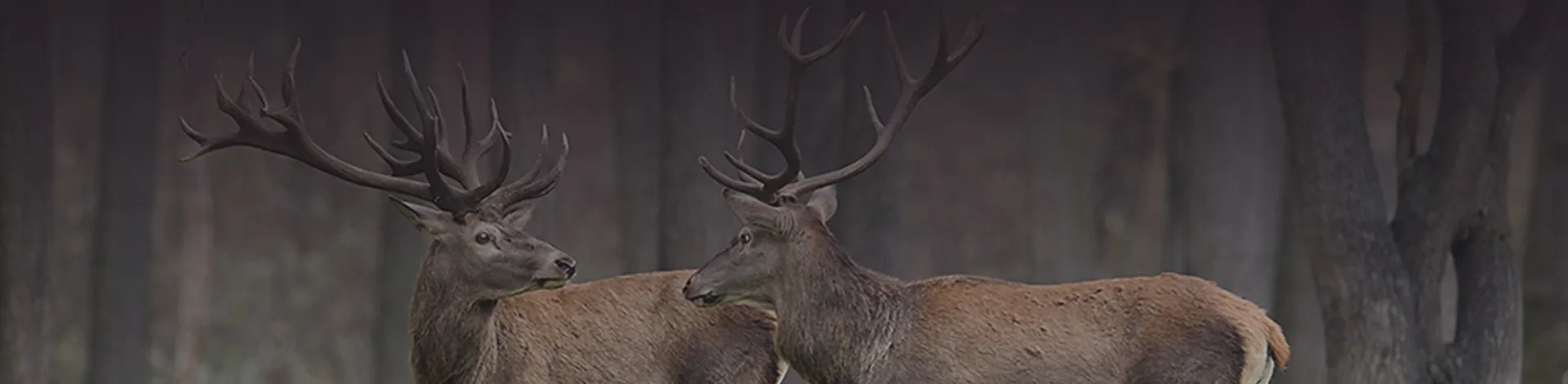
The main game species in Hungary is the red deer. In ancient Hungarian mythology, the fate of the Hungarians was entwined with the red deer - according to legend, the ancestors of the Hungarian people, Hunor and Magor, reached the Carpathian Basin by chasing a red deer stag.
people, Hunor and Magor, reached the Carpathian Basin by chasing a red deer stag. Over the thousand-year history of the Hungarians, the red deer has retained this mystical role among Hungarian hunters. The rutting season is the most eagerly anticipated event and in early October trophy exhibitions are held nationwide, where trophies shot that year are on display.
In February, "shed hunters" flood the forests - those who were not given the opportunity to hunt, or who do not want to -, no ban or threat of sanctions scares them away, they go, collect and post on social media who has found what.
The red deer also holds a special importance among German-speaking hunters, the term “Lebenshirsch” meaning “stag of a lifetime,” is widely known, despite today’s broadened world of hunting opportunities, this expression still refers to a red stag, not a lion or a leopard.
Red deer are animals of expansive forests, thriving in areas with high forest cover and room to roam, they occupy different habitats throughout the seasons, often crossing the boundaries of hunting districts. They are sensitive to disturbance and will abandon areas if repeatedly disturbed.
Wind direction also greatly influences their behaviour. During the hunting season, in large populations, the gathered herds typically move against the wind and they will relocate if there are strong northern or southern winds.
As with all wild game, red deer prefer forests that provide cover at their own body height which areas usually offer food as well. Such forests include mature oak and beech woodlands with dense undergrowth and they are also fond of the fresh shoots of young black locust (acacia) stands. In Hungary, red deer are found in Transdanubia, the Northern Central Mountains and the Danube Tisza Interfluve.
Red Deer in Transdanubia
The largest populations of red deer live in Southern Transdanubia particularly in the counties of Zala, Somogy and Baranya and the individuals with the best trophy weights also come from here. The average trophy weight shot in September is close to 8 kg. Outstanding hunting areas: Bóly, Sellye, Siklós, Lábod, Nagykanizsa, Tapsony, Marcali, Gemenc and Kaszó.
In Western Transdanubia, Vas County and Győr-Moson-Sopron County there are significant numbers of deer though it is rare to encounter a record number of deer trophies. The average rut trophy weight ranges between 6–7 kg. Outstanding hunting areas: Sopron, Lajta Hanság, Káld, Röjtökmuzsaj and Sopron.
Central Transdanubia is the part of the country north of Lake Balaton and in the Bakony, which is part of the Transdanubia Central Mountains there are a significant number of red deer. The average rut trophy weight is around 6–6.5 kg. Outstanding hunting areas: Zirc, Uzsa, Ugod and Fehérvárcsurgó.
Northern Transdanubia, the ranges of the Transdanubian Central Mountains from Lake Balaton towards the capital: Vértes, Gerecse and the Buda Mountains. The red deer population living here is of medium quality with an average trophy weight of around 6 kg in September. Outstanding hunting areas: Tata, Süttő, Bajna, Csákvár and Budakeszi.
Red deer in the Northern Central Mountains
The red deer population in the Northern Central Mountains is of poor or average quality in terms of trophy production. The area is rich in beautiful hunting lodges and boasts picturesque and wild landscapes. Anyone who visits this region during the rutting season will probably not return home with a 10 kg+ red deer trophy but with lasting experiences.
The Northern Central Mountains extend from the Danube Bend above Budapest to the Ukrainian border and the length of the mountain range as the crow flies is 200 km. Outstanding hunting areas: Diósjenő, Királyrét, Kemence, Mátrafüred, Galgamácsa, Radvány and Szín.
Red Deer In The Great Plain
Red Deer In The Great Plain In the eastern region of the Great Plain, in the Danube–Tisza Interfluve, red deer have become established over the past 50 years, having migrated from the Gemenc floodplain and seems to have found a suitable home here. Interestingly, some individuals with exceptionally large trophy weights are also harvested - though not in large numbers and not every year. Here, rutting begins earliest in the country, often already in August, and by mid-September the forest has already fallen silent.
Outstanding hunting areas: Hajós, Homokmégy, Sükösd, Császártöltés, Jánoshalma, Karapancsa and Lenes.
Red Deer Hunting:
The most successful way to hunt red deer stags is during the rutting season, which depending on the geographical location, lasts from 1 September to mid-October.
In September, the Hungarian forests have an incomparable atmosphere, hearing a stag roar on a cool, misty September morning is an unforgettable experience for every hunter.
The classic method of red deer hunting is individual hunting, whether during the rut or in the winter season for culling stags or hinds. The guest hunter accompanied by a local professional guide, either waiting in a high stand for the game to arrive or stalking through the forest, in some cases, a horse drawn cart is used, allowing the hunter to get within shooting distance of the chosen animal.
Red Deer Hunting Season:
- mature stag (shootable trophy buck): from 1 September until 31 October
- cull stag: from 1 September until 31 January
- spiker (young stag): from 1 September until 31 March
- doe: from 1 September until 28 February
- doe: from 1 May until 28 February
- fawn: from 1 September until 30 April
Hungarian red stag trophies on the World Ranking List
| Location of harvest | Date | 24-hour trophy weight | CIC score | World ranking position |
| Karapancsa | 1986 | 14,50 | 271 | 3. |
| Pusztakovácsi | 1981 | 14 | 269,89 | 6. |
| Lábod | 2001 | 16,81 | 265,67 | 7. |
| Vörösalma | 2002 | 14,05 | 263,88 | 8. |
| Kerecseny | 2000 | 13,98 | 236,30 | 9. |
| Szentpéterfölde | 1992 | 14,70 | 261,29 | 12. |
| Hahót | 1985 | 16,40 | 260,07 | 15. |
| Noszlop | 1992 | 12,68 | 260,02 | 16. |
| Bajcsa | 1989 | 14,75 | 257,88 | 17. |
| Nagykanizsa | 1981 | 11,75 | 257,15 | 18. |
| Bezeréd | 1982 | 12,95 | 256,97 | 19. |
| Kisbárapáti | 1985 | 13,75 | 255,45 | 23. |
CIC scoring system
170-189.99 points: bronze
190-209.99 points: silver
210 points and above: gold